
Can choosing a space cabin homestay for returning home to start a business really win?
Travel has long broken away from the shallow mode of "check-in and photo taking", and more and more people are pursuing a vacation experience that combines "returning to nature+comfort and convenience". The homestay industry has also shifted from "homogenization and competition" to "characteristic breakthrough". And as a "dark horse" in the cultural and tourism market in recent years, spacecraft homestays have become the first choice for many entrepreneurs returning home - but is it really as easy to do as it seems? What pitfalls should beginners avoid when entering the game? Today, based on practical cases, we will explain the advantages, adaptation scenarios, and entrepreneurial logic of space cabin homestays.

Let's first clarify a core conclusion: the popularity of space cabin homestays has never been about "looks and luck", but has precisely hit the current consumer demand and entrepreneurial pain points. Especially for promising young people who return to their hometowns to start businesses, it is almost one of the optimal solutions for "low threshold, high return, and strong drainage".
Firstly, it perfectly solves the "pain points" of traditional homestays. Traditional homestays mostly rely on the renovation of old houses, with long construction periods, large investments, and serious homogenization of styles, making it difficult to attract young tourists; The space cabin homestay adopts modular prefabrication design, with factory prefabrication and rapid on-site assembly. It can land in as fast as 4 hours and complete batch deployment in 25 days, greatly shortening the start-up cycle and reducing the initial investment cost. More importantly, it has extremely low requirements for the site, and can be flexibly deployed by the seaside, mountains, forests, and rural secret areas without damaging the original terrain. The approval process is also simpler, and many areas classify it as "cultural and tourism equipment", which only takes 14 days from project approval to operation, shortening the approval time by 5 months compared to traditional homestays.
Secondly, its "differentiation advantage" is sufficiently obvious, with inherent traffic attributes. The current mainstream tourists, especially those born in the 2000s, young couples, and families with children, are no longer satisfied with "having a place to live", but rather pursue "a sense of experience and the ability to produce films". With the core of "nature+technology", the space capsule home stay is a very simple interior design, equipped with star rated hotels. The 270 ° panoramic french window directly "moves" the mountain forest, the sea view and the star sky into the room, lies down to watch the stars before bed, and wakes up in the morning by the sun. This immersive experience is irreplaceable for traditional home stay. What's even more considerate is that the cabin can be customized with themed decorations, such as star themed curtains, space domes, and dolls, which can attract families with children and meet the social sharing needs of young people. With just one snap, it can become an internet celebrity with its own promotional attributes.
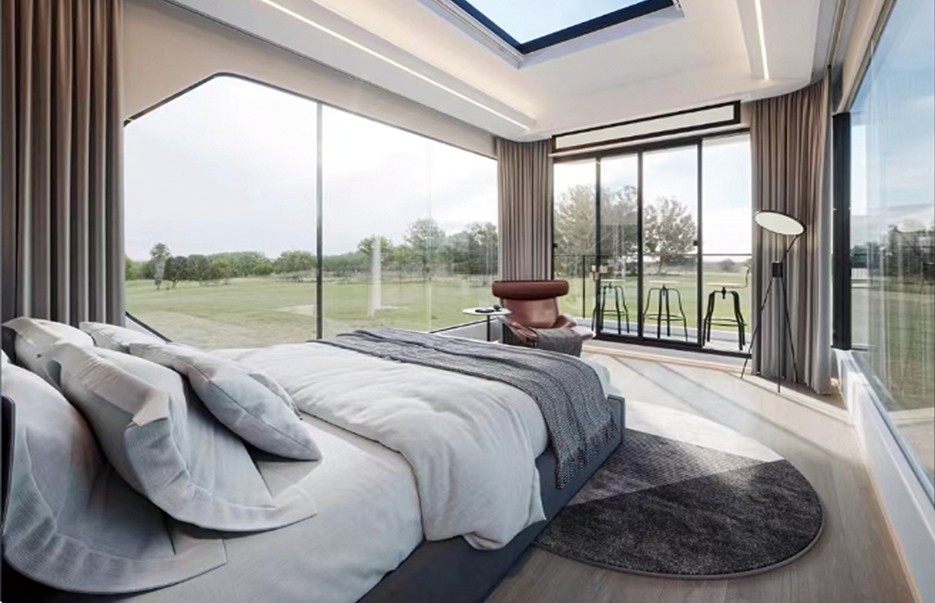
Many people may ask: Is it better to choose a seaside or a mountain forest as a space cabin homestay when returning home? In fact, both have their own advantages, and the key depends on the resource endowment of the hometown. The space capsule by the seaside can feature "sea view vacation+listening to the waves and sleeping", paired with terrace barbecue, sunrise viewing and other experiences, suitable for summer heat dissipation and weekend micro vacation crowds; The spacecraft in the mountains and forests highlights the "forest tranquility+health and leisure", paired with hot springs, tea making, hiking and other scenes, with the selling point of "escaping the city and relaxing the body and mind". It can even be combined with rural culture, allowing tourists to "see the mountains, see the water, and remember their nostalgia".
Finally, I would like to remind all returning entrepreneurs that the core competitiveness of spacecraft homestays lies not only in hardware advantages, but also in "emotional empowerment". Like many successful homestays, the host's attitude towards life and the cultural heritage of their hometown are the key to retaining tourists. Integrating the love for hometown into the details of homestays, such as pairing local specialty cuisine and explaining rural stories, can make the spacecraft not only a "accommodation container", but also an "emotional carrier", in order to achieve long-term profitability.
In summary, space cabin homestays are not just trendy gimmicks, but an inevitable choice in line with the upgrading of cultural and tourism consumption. For young people with hometown resources and entrepreneurial enthusiasm, it has a low threshold, strong adaptability, and good drainage effect. As long as they choose the right scene and pay attention to details, it is difficult not to be popular.
徐茹要求
Consultation Type
WhatsApp*
email*
Country/City*
Order Quantity*
Project Type
company name
title


简单版
邮箱验证*
*


